Showing posts with label #Africanculture. Show all posts

Saturday, September 14, 2019

Ghana, the Africa's golden child.

Africa is a rich and diverse continent, where you can find almost everything. Yet, some countries are plagued by corruption, wars, and exploitation.
My blogs are not generally aimed to advertise one or another place; I don't get money from travel agencies to sell a product. Rather, I would like to give an informative and, as accurate as possible, experience about this wonderful continent, full of marvels and contradictions.
After the days spent in Togo, it was the time to move forward with our travel plan and reach the next destination: Accra.
Ghana is well known for being a very rich country, famous for the cocoa plantations, wild honey, textiles and of course, gold.
The first impression we had about the city is that the infrastructures are more developed, which gives to the city a western image, still keeping the beautiful African identity. The beach is something you really want to indulge in, although it is quite far from the heart of the city, the place you want to visit to have a taste of Ghana's life.
When during the day, the beach is a place for great sunbath, surfing, and fun activities, during the night, the beach transforms itself and hashish and marijuana dominate over the scent of the sea.

We reached our hotel, which was located in a convenient area where also all the embassies had their sees.
Despite being also very close to the airport, we didn't get any troubles with the air traffic noise, as one might imagine. The city is very well kept and offers many interesting sights, one of which is the market in the center of the city. That is a place you need to see, as we got lost in the middle wondering where we should have gone to reach the main street. The only landmark we could find was the Sun and the knowledge that the beach was in the South-East direction. Merchants were shouting from their stands, music played all around, scents of grilled food, fish, spices filled the air. Although the place was crowded, it was one of the most interesting experience to walk around and witness the heart of the city beating with enchanting tunes.

The market doesn't have fixed boundaries, it can stretch for streets and squares and slowly its boundaries blend with the normal streets gradually fading away.
Nevertheless, the Market experience was something we kept as a one-day experience, as there were so many more places to visit and to see.
As we explored the city, we had to walk for quite long distances every day, however, we also needed sometimes to call for taxi drivers, and there you need to bargain as much as you can. The prices are not fixed, they are decided, depending on how the taxi driver feels on that day, or who is asking for a ride, (is it a woman or a man, is she/he young or old, is a foreigner or a local). That considered you might have a very expensive ride for a couple of minutes drive and a very cheap one for one hour drive. You need to bargain and be ready to have a nice walk if you think the price is getting out of control.
Another problem with taxi drivers is that they seem not to have any idea about their city. In many cases, we needed to navigate them to the places we needed to go, and I found it hilarious that we knew Accra's locations better than they did.

Walking the streets gives anyway the great chance to take nice pictures of the surrounding and of the wildlife, like the colony of fruit bats that lives happily within the city.

It is also interesting to see all the important sites like the presidential palace, which was quite close to our hotel and gave a nice view both during the day and night.

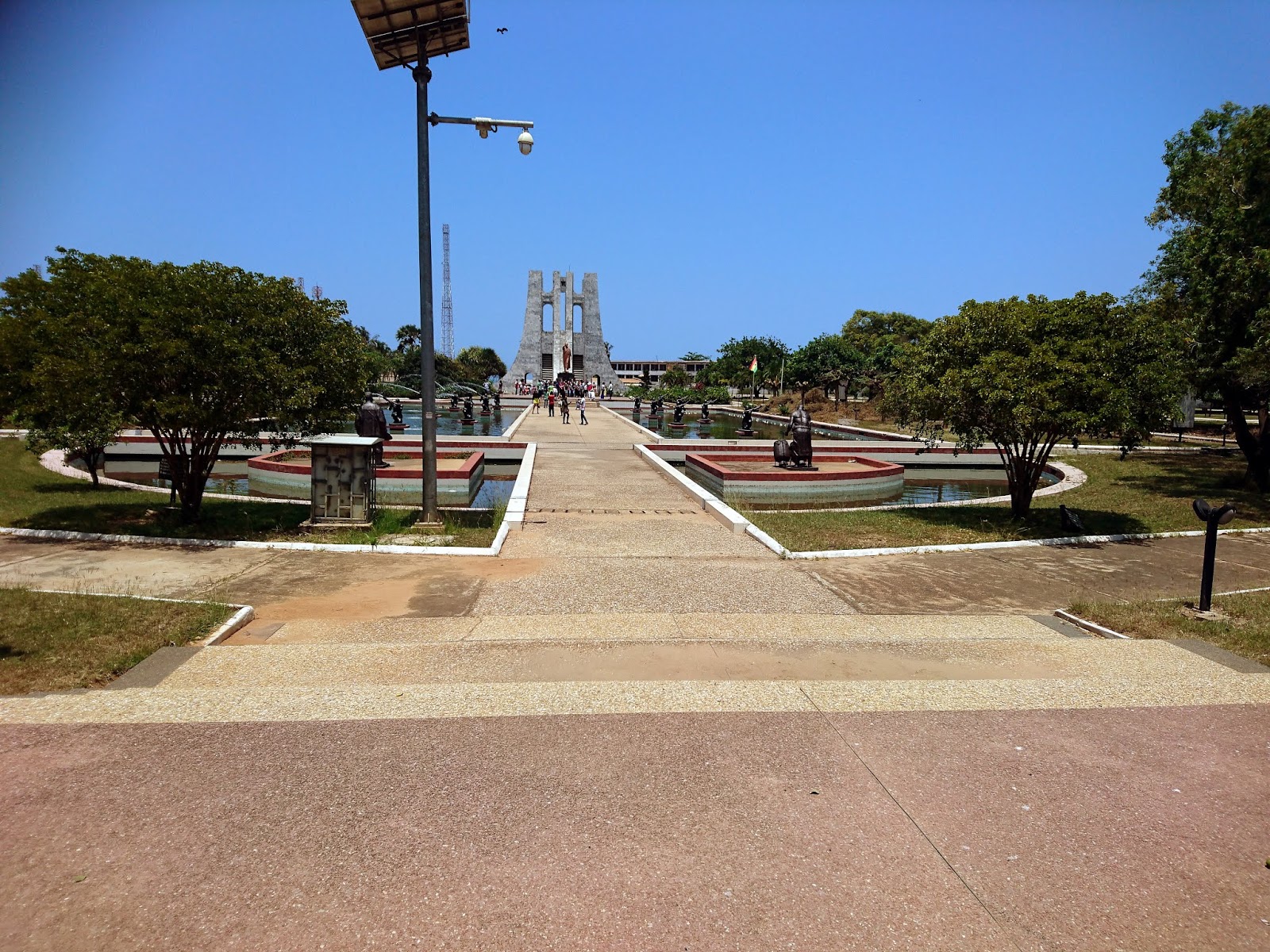
Together, of course with the Kwame Nkrumah Mausoleum and memorial park, which is located in downtown Accra. It is dedicated to the prominent Ghanaian leader Kwame Nkrumah. The memorial complex was dedicated in 1992
and is situated on the site of the former British colonial polo grounds in Accra.


With that, I hope you have enjoyed this short tour of Accra. I will return next week with another pearl of Nigeria, where our loop journey ended with the visit to the Conservation Park. Don't miss it!


Saturday, September 7, 2019

Togo and the Voodoo heritage

After our stay in Benin, it was finally arrived the time to reach the next destination, Togo.
This was a place where we could find most of the answer to my questions about Voodoo. Together with that, I collected some material for a novel I am planning to write.
Undoubtedly voodoo, as a religion, was born in Benin, Yet, although it is still one of the main religions practiced in the country, it seemed more widespread in Togo. Perhaps it is because people in Benin seemed reticent in talking about it, or because it has been challenging to get any contact there. Whatever the reason is, in Togo, people seemed keener to talk about it and explain to us a little bit of the religious practices.
The first thing is that Voodoo is wrongly associated with black magic or with evil forces. This is absolutely a myth that needs to be debunked. Voodoo is about healing and evoking the spirits for good purposes. Whether for healing disease, ask for the end of a long period of drought, to maintain peace inside the family, the spirits and the Gods are summoned for good practices.
Voodoo is a way of life for many people in Togo and Benin. It consists of about 100 divinities, which essence governs the Earth governing the forces of nature and human society.
The divine creator is called Mawu and is a female being. It is believed to be an elderly woman who is gentle and forgiving. She owns all the other gods.
An interesting part of this journey was the visit to the MarchĂ© des FĂ©ticheurs in the Akodessawa district in Lome. It is said to be the largest fetish market in the world. Perhaps just because there aren't many competitors, a visitor might find it not as big as they figured out in their mind. Nevertheless there people find all the necessary for worshipping and also ingredients for traditional medicine.
According to what they told us, the dead animals in the market were found in the forest already dead. Some others were farm animals who have been used for the sacrifice (and then eaten with the community). Considering the relatively small amount of corpses that are allowed to dry, I might also think that this is not far from the truth.
Just like I always say, when traveling to other countries, and particularly when getting in touch with different heritages and religious practices, we need to unlearn and forget from where we come from. This allows us to look at them with fresh eyes.
Asking questions to get a more in-depth insight into the cultural heritage will help to understand.
So are you ready for a full immersion into the culture of Voodoo?
Good, follow me...

This young man was a practicing priest. Not everyone can become a priest, This is something that is transmitted through the family. Therefore only the sons of the priest can become one day priests themselves.


Now to the question, that might come to your mind, "did you buy anything?" The answer is, "Yes, I did, but mostly it included wooden masks and other artifacts."

Lome has lovely beaches, which could have great potential for tourism. Yet, they are not really well kept, and most of the places seemed to be something to avoid rather than something to enjoy. 

Nevertheless, the restaurants on the beach offer a great variety of food and I have to say, absolutely delicious. I just indulged myself in their local fish specialties, and I could not get really enough. It was a real pity knowing that we needed to leave the country after a few days. I would have remained just for the food for much longer.

I hope I didn't creep you out with this cultural insight. As for me, I felt extremely inspired for the novel I've started to write.

I wish you a great weekend!


Among tiny countries and high peaks

 There’s something fascinating about opposites and how strength can exist in fragility, how something small can endure against something vas...